
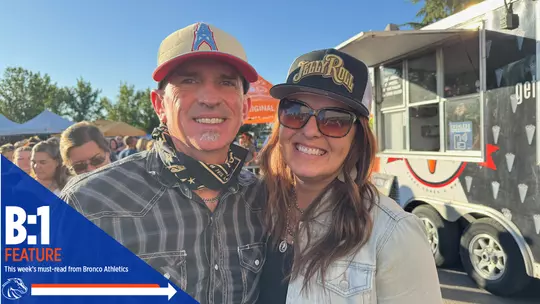
How A Boise State Staff Member Used The Artist To Heal His Mind and Body
Alex Semadeni
Known for his eccentric and humorous personality, Andy Atkinson, the director of information technology for Boise State Athletics, was clearly in a funk. Friends and family alike could easily see a drastic change in his energy and enthusiasm.
After his heart nearly failed him three years earlier, Atkinson, who is frequently referred to as Double A around the office, sunk into a deep depression.
Encouraged by his wife, Jenn, and family members, Atkinson slowly worked himself back to full health, in part by using numerous techniques to change the negative thoughts in his mind to positive ones. One of these methods was coined by Atkinson himself.
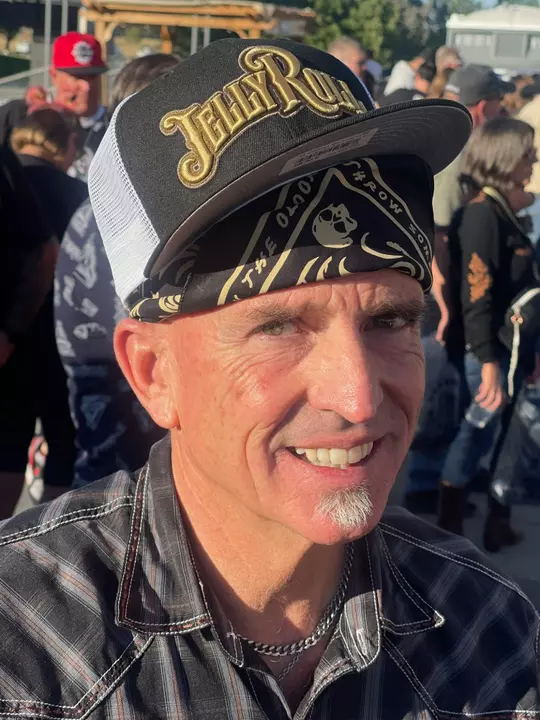
J.R.M. Jelly Roll Meditation, named after the chart-topping musician.
“Every night I would bump Jelly Roll in the shower,” he said. “I would just jam with tons of bass. It was 30 minutes of just getting into it with his lyrics, using his music as a connection to something bigger than myself. It sounds weird but I could not wait to get in that shower with Jelly Roll. So I kept that going every single night.”
I guess rock bottom's where I'm comfortable. Both my feet planted when most people would've panicked. I embraced the storm, I found beauty in what was damaged. I'm not afraid of the bogeyman. Instead, I look at him like he's a friend. There’s not a monster out there in the world. That’s scarier than the one that’s within.Creature - Jelly Roll
In May of 2022, Atkinson developed a cough he couldn’t shake. He began to rapidly lose weight, and soon realized he couldn’t walk across the famed Boise State football field without taking a break.
His rapid decline was evident to his family members during his son Cooper’s 21st birthday trip to Las Vegas. While wandering around the strip, Atkinson couldn’t keep up with his family and ultimately had to turn around and return to his room.
That night, his daughter, Kendall, couldn’t sleep as she listened to his breathing. A nurse, she insisted he go to the doctor for a chest X-ray immediately upon returning to Boise.
Atkinson did that Monday and was initially diagnosed with pneumonia and put on antibiotics. That Wednesday, he served as the umpire for the athletic department’s annual kickball game. That night, following the festivities, things got substantially worse.
“I couldn’t lay down, I couldn’t sleep, I couldn’t breathe unless I was sitting up,” Atkinson said. “It felt like my chest was being crushed like I was on the bottom of a 45-person dogpile. My wife begged me to go to the emergency room but I had resisted going. I was acting like it was going to be fine but underneath I think I knew something more serious was going wrong.”

The next day, Atkinson drove to the clinic on Broadway. Due to the long wait time, he and Jenn quickly audibled and headed over to the emergency room at St. Luke’s.
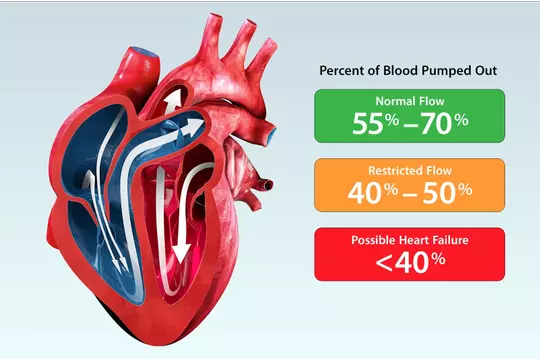
After roughly nine hours of inconclusive results, the doctors decided to do an echocardiogram, a test that in simple terms, looks at the heart’s function. One of the measurements is the heart’s ejection fraction (EF), which essentially shows the percentage of the blood the left ventricle of the heart pumps out to the rest of your body.
A normal EF typically ranges from 55% to 70%. Heart failure typically occurs if the number reaches below 45%. A defibrillator implant is suggested if the number reaches 35%. Hospice care is usually recommended between 15-20%.
Atkinson’s EF came back at 7%.

“The result of that test was congestive heart failure,” he said. “It was not just the beginning stage, it was a complete failure. It’s a chronic condition that tends to worsen over time.There were all sorts of grim comparisons. It was some pretty awful news.”
His oldest son, Jordan, who also works in the medical field told him, “That’s not good news, dad.”
By the time he left the hospital, Atkinson had a plethora of medications, an external defibrillator, a cardiac rehab appointment, and a long list of changes that he would have to make. Some of those changes included not climbing stairs, not exerting himself and to avoid salt.
He would also take an echocardiogram every three months to track improvement, though the doctors cautioned him not to get his hopes up.
The medicine initially resulted in slight improvement. Following his first echocardiogram at the three-month checkup, his EF had risen to 13%.
Around this time, the Boise State football team was set to kick off its 2022 campaign in Corvallis, Oregon against Oregon State. In his role with the athletic department, Atkinson was responsible for the coaches’ headsets and traveled to every road game. (He later aided in responsibilities of the coach-to-player communication following the rule change prior to the 2024 season).
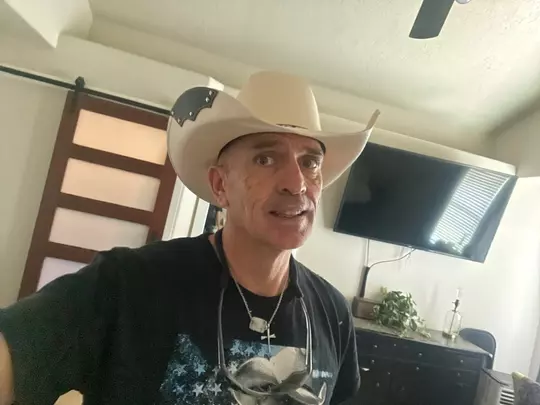
Unable to perform his usual duties, Atkinson had settled into this chair at home to watch the game. Traveling with the storied football program was one of the favorite parts of his job, and he had a pit in his stomach as he got ready to watch the Blue and Orange behind the unfamiliar view of a television screen.
Kickoff against the Beavers was scheduled for 8:30 p.m. MT. A minute before, at precisely 8:29 p.m., Atkinson’s phone began to ring. It was Boise State athletic director Jeramiah Dickey. Not wanting to elevate his stress, Atkinson ignored the call.
“I immediately started worrying about why he was calling me,” Atkinson said. “What could be going wrong? Are the headsets down? Can the coaches not talk to each other? It might have been the biggest game of the year. I couldn’t have the conversation with him - I couldn’t go there mentally. I was supposed to be there. That's the first time I'm not there. I couldn’t get out of bed, let alone have a conversation a minute before kick trying to troubleshoot something. I was just in a bad place.”
However, the phone call was the complete opposite of what Atkinson was expecting.
“He left a voicemail that made tears come down my eyes,” Atkinson said. “He called me a minute before kick to say that he was thinking of me and that he hoped I was doing well. Talk about epic. Talk about being elite. That leadership just starts with love. That was so powerful.”
“After hearing that voicemail I just broke down,” Atkinson said. “It made me think that maybe I could do this. I have good people around me.”
Medically however, Atkinson’s heart wasn’t improving. His next echocardiogram, six months after his initial diagnosis, came back at 19%, a slight improvement from the 13% three months earlier. His results remained the same at the nine-month mark, and took a slight dip on the year anniversary of his initial diagnosis. It was at this point the doctors decided to pivot.
“My results were still technically in the hospice range,” Atkinson said. “That's when two of the top cardiologists in Boise came in and told me that all the medication should have been doing more for me and that the data indicated I wouldn’t get better. If I wasn’t getting better now then I was probably declining. They suggested putting a defibrillator in my chest. They told me to simplify my life. They suggested that I retire and that I should probably start looking to get my affairs in order.”
Atkinson was left speechless, a rare state for all those that know him. Andy and Jenn hardly said a word to each other on the way out of hospital.

“I’d ridden my motorcycle that day because I met my wife there for the appointment,” he said. “I looked at her and said, ‘I guess I don’t need to wear my motorcycle helmet anymore.’ Turns out that’s not the right thing to say to your wife. She lost it. She was already so scared.”
Atkinson himself did not take the news well. Deep in the throes of self-pity, Atkinson retreated to his bedroom, where he spent nearly all of his time recycling through old television episodes on Netflix. His normal, energetic self was rarely seen.
“I was in the deep stages of grief and depression,” Atkinson said. “I had no capacity to care. We all know people that are near the end of their life and they just have no passion, no energy, no drive, and they just give up. I must have been close.”
Atkinson rarely left his bedroom, and his family members became increasingly worried about his mental state. After three consecutive days in his bedroom watching Netflix in the dark, Jenn came in, gave him a long hug, and whispered six life-altering words in his ear.
“Promise me you won’t give up.”
I am not okay. I'm barely getting by. I'm losing track of days. And losing sleep at night. I am not okay. I'm hanging on the rails. So if I say I'm fine. Just know I learned to hide it well.I Am Not Okay - Jelly Roll
Not wanting to let his wife and family down, Atkinson searched for a way out of his depression. Though he was diligent with his medication, and reluctantly scheduled a defibrillator surgery, he desperately looked for ways to change his outlook.
Eventually, he had an epiphany: If the human mind can make us sick, maybe our minds can help us heal.
“That’s when I said, ‘I ain't doing this,’” Atkinson said. “‘I'm not going down this way. I’m not going to accept this assigned meaning. I'm going to do something about it.’”

He began researching everything he could get his hands on about the power of the mind. He discovered Dr. Joe Dispenza, an expert in the field of neuroscience, who encouraged four different types of meditation. He researched solfeggio frequencies as a meditation tool. He studied the power of the placebo effect, and most importantly to him, leaned on his faith.
“I dug into everything that I could,” Atkinson said. “I read, listened to and watched everything that dove into the power of the mind. Our minds are extremely powerful and efficient and they'll assign meaning to everything that comes in. Most of the time, we don't even know it. Our minds are overly efficient. I started thinking about how powerful our minds are. I was thinking that maybe there's a way to heal through changing the tone of my thoughts.”
One of the consistent themes that Atkinson kept coming across in his research was consistent journaling. Writing was something that Atkinson despised doing (‘I freaking hate it’), but after seeing that specific advice in numerous places, and searching for a way out of his self-pity, he decided to go for it.
“All my first journal entry said was, ‘I feel like shit.’ That was it. I remember thinking, ‘What am I doing? Am I even doing this right?’ I had a lot of pure doubt as you can imagine. But I stuck with it and was diligent with it every night.”
His journaling evolved from the initial negativity. Atkinson talked about the progress his heart had made from 7% to 19%. He wrote about how grateful he was for what had already happened and to have a working heart each night. He wrote about all things he was thankful for, specifically his family.
“I wrote every single night, over and over again,” Atkinson said. “I graduated into adding elevated emotion. I made myself feel like I was getting better.

“And then I added J.R.M.”
Every night after journaling, Atkinson would hop in the shower and listen to roughly 30 minutes of music from Jelly Roll. The famed musician's lyrics resonated with Atkinson, who felt inspired by the words while belting them out nightly.
“His lyrics are raw,” Atkinson said. “His story is a true testimonial of unwavering belief. Something about the words in his music just speaks to me. His lyrics talk about his pain and overcoming his addiction is so powerful. I didn’t have the addictions specifically that he was singing about, but I think we all have addictions in different ways so anybody can receive that message.
“I was into Jelly before Jelly was cool,” Atkinson said. “One of the first songs that I was attracted to was ‘Creature’. There's not a monster out there in this world that's scarier than the one within. That speaks to me. ‘Smoking Section’ just spoke to me. I would jam out to ‘Church’ on the way to work. And ‘Save Me’ – I’ve never cried so much to a song more than ‘Save Me.’”
Somebody save me. Me from myself. Something inside of me’s broken. I hold on to anything that sets me free. I’m a lost cause. Don’t waste your time on me. I’m so damaged beyond repair. Life has shattered my hopes and my dreams.Save Me - Jelly Roll


Aided by his nightly Jelly Roll routine, Atkinson began to have a change of outlook. Inspired by his change of attitude, he added his goals of improving his ejection fraction to 45% to his nightly journaling routine. He also used elevated emotion while journaling.
“I would sit there and I would just start feeling joy while journaling,” Atkinson said. “I could almost force the chemicals in my body to move, it was strange. I started thinking that it could work. I was forcing myself to smile, to feel joy, feel this gratitude. As soon as negativity crept in or any thought of doubt, I flushed it and got right back into a walking meditation.
“I remember stepping out of the shower one night and telling my wife that this was going to work,” Atkinson said. “I told her that I was going to meet him one day. There was no doubt, no question about it. I had this unwavering belief. I couldn’t wait for my next test.”

His next cardiogram test jumped out to 33%. Atkinson was ecstatic and thrilled that his nightly routine was aiding his heart’s improvement.
Confident that his new routine was getting results, Atkinson cancelled the previously scheduled defibrillator surgery ('to my wife’s horror'). He was determined to turn this thing around and not need it. He doubled down on the journaling, doubled down on the praying, and doubled down on expressing gratitude. And every night he would hop in his shower and blast Jelly Roll.
“I had energy, I had passion, I had a drive in me,” Atkinson said. “I just felt different. It didn't matter what those tests showed me. It didn't matter what their tests said. I just knew I was improving. It was an amazing feeling.”
Leaning on his faith, he specifically journaled about the Moses Code, a religious meditation technique with origins traced back to Moses. He would repeatedly write out, ‘I Am That I Am’ in his journal. This became his mantra and this structured approach kept him deeply engaged in prayer, while preventing his mind from wandering. Every night, with elevated emotion and gratitude, he would write and feel the affirmation.
Atkinson was so confident heading into his next echocardiogram that his ejection fraction would reach 45%. The night before, he sent a text out to his family:
“Tomorrow is the big 45 test. My ejection fraction will be 45%. Just letting you all know. Unwavering belief.”
Atkinson took the test. The following day, he was in the hallway at the entrance to the athletic department office when he got the call with his results. It was 45%.
“All I could respond with was, ‘I know’,” Atkinson said. “I called the shot. I knew with faith, with connection, with that emotion, with that gratitude, with that meditation, that mindfulness – I knew I had done it. I found a formula that unlocked an assigned meaning and changed the narrative. I actually declared 45%.”
I, I let you drive around my mind. I can't count the times you made me feel like I'm nothing. Played me like a fool...like a fool. I can hear you in my head, in my bed when I'm dreaming. You try to be by friend but you're just blowing smoke. Oh, but now I ain't scared of telling you where to go. 'Cause I know you're nothing but a liarLiar - Jelly Roll
The latest ejection fraction result was a huge sigh of relief for Atkinson and his family, as it meant he received a year-long clearance from an echocardiogram. Atkinsons’ last took an echocardiogram a little over six months ago.
With his clean bill of health, Atkinson feels refreshed and recharged. He also knows the power of his mind, and is determined to share the power of the mind.
“Life doesn't come pre-packaged with meaning,” Atkinson said. “It's an empty canvas on which we can paint whatever we choose. This means we have complete freedom and responsibility to decide what our experiences mean to us. Why assign meaning to situations or circumstances? My goal now is to make life meaningless.”
He also spends a majority of his free time with his family, with whom he also credits for turning his life around.
“Jenn, my kids – they’ve all been so supportive,” Atkinson said. “I couldn’t imagine how scared they must have been through this process. For them to see this journey, seeing the grim diagnosis, hearing the doctor being perplexed about how I just walked in? They saw me use this power of growth. I hope it’s been extremely powerful for them to watch and witness this and believe that anything is possible.”

His family will be by his side when Atkinsons will see Jelly Roll in concert this summer, when the artist visits Albertsons Stadium as part of Post Malone’s Big Ass Stadium Tour on June 24. It will be the third time Atkinson will have seen the musician following his diagnosis.
“Jelly Roll has a message of hope, resilience and overcoming adversity,” Atkinson said. “He frequently emphasizes that people can change their lives no matter where they come from or what they’ve been through. I can’t thank him enough for being a tool. It would mean the world to meet him.”
His family was by his side the first time Atkinson saw the performer following his initial diagnosis when he performed at the Boise Music Festival in the summer of 2023.
“I was so excited to see him and sing all the words with him,” Atkinson said. “I was planning for it to be a JRM session on steroids. I was pumped. The second song in was ‘Son of a Sinner.’ I immediately started bawling and crying. My wife didn’t know what to do with me ugly crying all over the place. All my videos are shaky. I was videoing and it was like something just hit me. I had given that dude credit for saving my life. It was a spiritual experience. It was as if time stood still. The sky turned almost purple. The journey of what I had been through writing every night. The J.R.M. worked, just jamming all of his lyrics. What my wife had been through, what my kids have been through, it just all caught up to me and hit me at once.”
A little over a year later, Jelly Roll returned to the Treasure Valley, this time to the Ford Idaho Center in Nampa. Atkinson of course wasn’t going to miss it, but this time he came prepared.
“I prepped everybody that it might get ugly,” he said. “I brought some tissues. I expected the same reaction. I was preparing for it to be tough.”
However, Atkinson had a completely different experience.

“This time, I was more proud of myself,” Atkinson said. “I was proud of the power within, proud of the mindfulness within me. I had possessed that power all along. Jelly Roll was a tool I used, just like a few other tools I used along the way. We all have this power within us. We all have the ability to pick our tools and make anything possible. What a cool thing. I don’t think I teared up once. It wasn’t even close to my first experience.”
When Albertsons Stadium was announced as a stop on the latest tour, Atkinson couldn’t have been more thrilled. The concert will feature the man that Atkinson credits as a tool that saved his life singing on the famed Blue Turf, the place that Atkinson has gone to work for the last 18 years.
He immediately bought tickets, and in typical Double A style, those tickets are in the pit - as close as he can get. He isn’t sure what to expect the third time around, and at this point, he doesn’t care. He’s going to have a good time regardless.
“I took a pretty grim diagnosis and turned into a new assigned meaning in life,” Atkinson said. “My life is now meaningless and that’s awesome. I feel inspired to share this with people. I’ve been speaking to groups, large and small. I want to give people of all ages the awareness that our minds are so powerful. When we unlock that, we find a way to reject any assigned meaning to circumstances and situations. I want to have that impact on people. I want them to change their lives. I want to unlock that unwavering belief in someone else like Jelly Roll did to me.”