
A Game Without Sound
The Silence That Changed Everything
Alex Semadeni
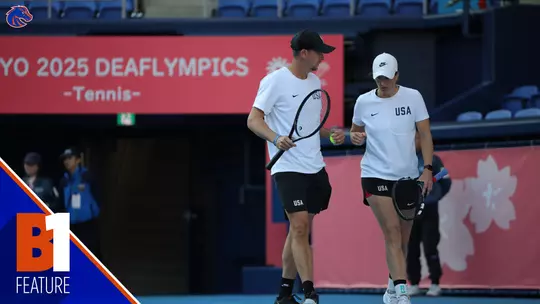
In the summer of 2013, Daniel Hangstefer and his sister, Emily, arrived in Sofia, Bulgaria, into a world they had never known.
They were there to represent the United States at the 2013 Deaflympics, an international event that brought together nearly 3,000 deaf athletes from more than 80 countries.
Hangstefer, now the associate coach for Boise State men’s tennis, was thrilled to represent his country but he had two concerns:
1.) Three years removed from a standout tennis career, he wasn’t in the peak form of his playing career.
2.) For the first time in his life, he would compete completely without hearing aids.
Hangstefer and his sister grew up deaf, but through the use of hearing aids, were raised in a “hearing” environment. At the Deaflympics however, hearing aids were banned, meaning the siblings would play the entire tournament without sound.
When the 10 days were over, his initial anxieties paled in comparison with the transformation he had experienced.
“I realized there was this whole world that I had never been in touch with,” Hangstefer said. “I learned so much about a community that I wish I had found sooner.”
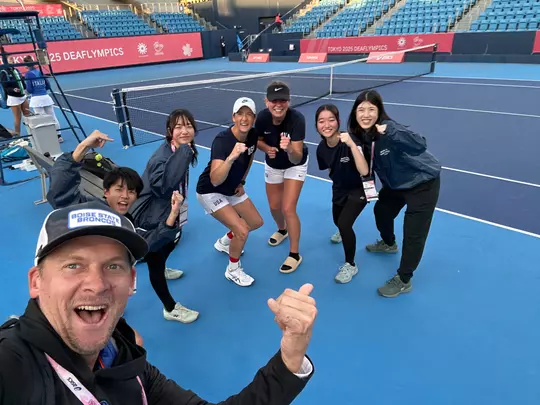
Hangstefer is one of six siblings, three of which were born deaf. His parents didn’t catch that his oldest sibling was deaf until a year after his birth. After that, every child was tested immediately after they were born.
The next three Hangstefer children were all born without hearing issues. When Daniel was born in 1987, his hearing loss was similar to that of his oldest brother. Emily, who was born two years later, had the same hearing loss.
The three have a hearing loss of about 60-70 decibels (dB) in each ear, which is in the moderate to severe hearing loss range. Though it hasn’t been confirmed why half of the Hangstefer children have hearing loss, the prevailing family theory is that his two parents had a hidden gene that expressed itself half of the time.
The siblings did not learn American Sign Language, and with the help of a large contraption they had to wear over their ears as children, communicated normally.
“I would wear these big, clunky aids that went around my ear with a wire that went into the earhole,” Hangstefer said. “Fortunately, I was homeschooled, so I didn’t experience much bullying or anything like that.”
He learned early on how to navigate conversations, and learned that there were some certain situations that would occur repeatedly.
“There were obviously times where people would clearly see that I couldn’t hear,” Hangstefer said. “They would cut the conversation short because they didn't want to repeat themselves. It was just a thing that you had to learn to deal with. I was used to it, and you learn how to handle those situations. You just learn how to put yourself in situations that allow you for success in life in general.”
When he became a teenager, technology had progressed enough where he could ditch the original hearing aids in favor of a pair that lived solely inside his ears.
“That was a godsend,” Hangstefer recalled. “The hearing aids got smaller, so the sweat and the wind were less of an issue.
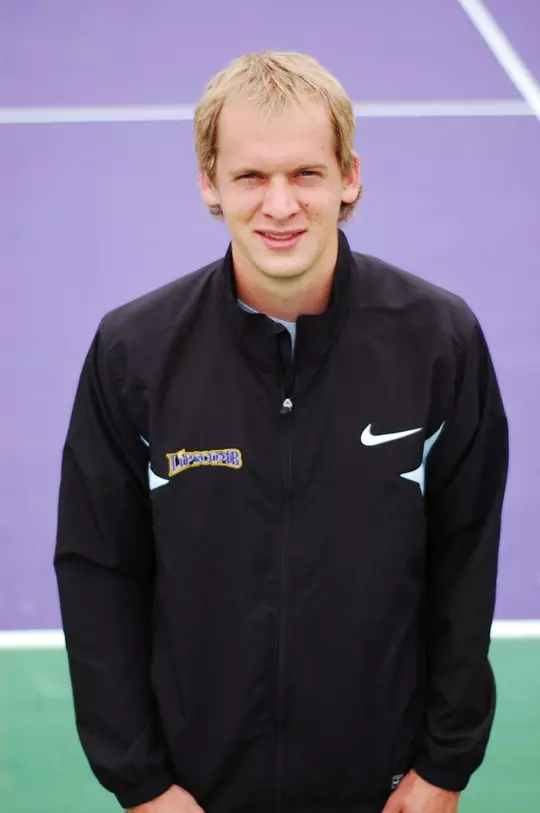
Sports were an avenue to a social life, and Hangstefer participated in nearly everything imaginable as a child. As he grew older, Hangstefer gravitated towards baseball, soccer and tennis. Though the hearing aids provided sound, there still were hurdles.
“Playing catcher in baseball was the worst,” Hangstefer recalled. “First off, batting was hard because the helmet over the hearing aids made for a very awkward set up. Secondly, as the catcher, when you would rip the helmet off to try and catch a foul ball, it would rip the hearing aids off too. You would be trying to make a play on the ball but then quite suddenly you can’t hear. Then you have to go find your hearing aids on the ground full of dirt after the play is over.”
As he grew older, it became increasingly clear that Hangstefer was quite adept at tennis. The individual nature of the sport allowed him to focus on just himself, and other than the wind and humidity of the Tennessee climate where he grew up, Hangstefer had limited barriers.
His prowess was recognized, and he accepted a scholarship to play tennis at Lipscomb. His skill set was on display from the start, earning him a place on the 2007 Atlantic Sun All-Freshman Team. Throughout his career, he played at the top two positions in singles and the No. 1 slot in doubles.
After graduating in 2010, he accepted a graduate assistant coaching position at Midwestern State, a division II school in Wichita Falls, Texas. To help pay the bills, Hangstefer worked four jobs, including a job at the local country club. There, the head pro, Johnny, told Hangstefer he used to coach at the Deaflympics and encouraged the young coach to seek more information.
Given his successful collegiate tennis career, it was a no-brainer that he was talented enough to be on the team. He encouraged his sister Emily, who had just graduated after a four-year career at Chattanooga, to join him. Hangstefer also recruited another player, Laura Marvets, to the team, who ended up competing with his sister in women's doubles.
Before the trio traveled across the Atlantic, they were going to have to make a significant adjustment to their game. Due to Deaflympic rules, he wasn’t going to be allowed to use his hearing aids. To prepare, he spent several months training without the use of his hearing aids to prepare for this adjustment. It was a bizarre change, to say the least.
“It’s really different when you play without hearing aids,” Hangstefer said. “Normally, I can hear everything — my racket, my opponent, the courts around me. Without hearing aids, I can’t hear anything except for a faint sound when my racket hits the ball. You’re forced to focus only on what’s in front of you.”
By the time he arrived in Bulgaria, he was getting used to the silence; the lack of repetitive tennis sounds during play. What he wasn’t prepared for was the difficulty in communicating without his hearing aids, specifically the umpires and opponents.
“They came up with different ways to grab your attention when they needed to,” he said. “The umpires would have a big yellow flag they would wave. Communication was hard. Firstly, I couldn’t hear, but then secondly, they didn't speak English well. There’s this whole communication barrier that's very interesting. But you get by and you learn how to deal with that.”
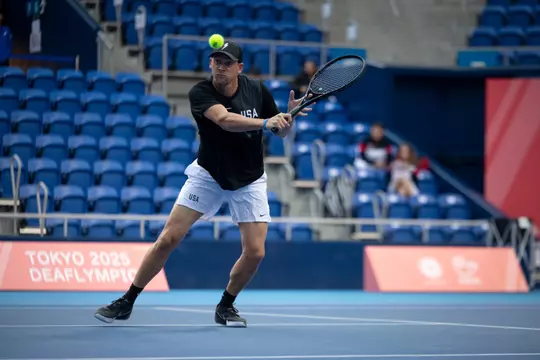
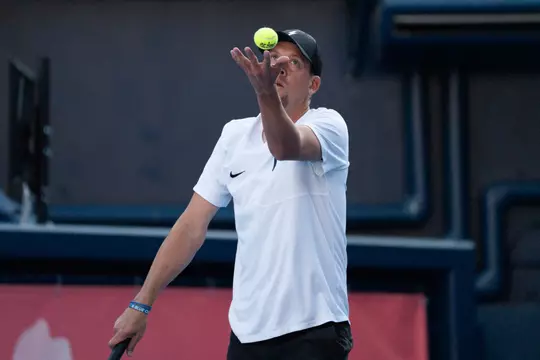
Competing in singles, doubles and mixed doubles, Hangstefer had plenty of reps to adjust to the newfound reality. In men’s doubles, Hangstefer and his partner were eliminated in the second round in a 6-3, 6-2 defeat. He had a bit more success in singles, winning a pair of matches before falling to the eventual gold medalist in the third round.
As fate would have it, Hangstefer found the most success playing alongside his sister in mixed doubles. The pairing won four consecutive matches in straight sets to reach the championship final. There, the duo fell 6-3, 6-3 to claim a silver medal in the mixed doubles division.
His sister and her partner won all four of their matches in straight sets to claim the gold medal in women’s doubles. The two medals were the first tennis medals the United States had claimed in 16 years.
“That was a really awesome experience,” Hangstefer said. “For my sister and I to grow up deaf together and then have that sort of experience together, there’s really no words for it.”

Though the success on the tennis courts created an unforgettable experience, the community that Hangstefer and his sister were exposed to became the highlight of the trip.
“Because I grew up in a hearing household, I had no idea this entire world existed,” he said. “What I learned over there was that there are thousands of athletes that have similar stories to me. Half of them understood sign language and half of them didn’t. Half of them are verbal, half of them are not verbal.”
He was taken aback by the familial aspect of the deaf community, who welcomed him in with open arms. One of his many takeaways was about how those in the deaf community referred to themselves by a signed name.
“Learning their terminology was so interesting to me. Most people in the deaf community have a signed name. When talking amongst themselves, they don’t sign their name in sign language every time. They’ll actually spell it out once and then end with their signed name. You only get a signed name when you’re involved in the community, and it must be assigned to you by an actual person from that community. I didn’t know any of that.”Daniel Hangstefer
By the time he left, some of the athletes he had met gave him his own signed name. Though Hangstefer and his sister found success on the court at the Deaflympics, there was no prouder moment than receiving that special name.
“It made me feel like I was part of that group,” he said. “I felt like it was part of me, even though I don't speak sign language. It’s amazing that they would even do that.
“My sign name is the letter, D, and then pound the chest,” he said. “Basically what it means is Big Heart Daniel. I felt like it was part of me, even though I don't speak sign language. It’s amazing that they would even do that.”
Following his Deaflympics debut, Hangstefer competed in several more deaf events, including a Davis Cup-style event in his home state of Tennessee and the World Deaf Championships in Nottingham, England, where the Hangstefer siblings claimed a gold medal in mixed doubles.
“I loved being able to put more time into a community that I knew so little about,” Hangstefer said. “It was awesome to be able to represent my country too. It was such a unique experience to get to wear the American flag. I still have my USA gear to this day.”


He visits an audiologist once a year, where he undergoes a series of tests to test his hearing in each ear. With the modern hearing aids, the audiologist will adjust each aid specific to how each ear recognizes the quality and pitch of specific movements. The aids have to be adjusted routinely, as specific letters can come across each ear differently.
“It takes time to adjust to the different sounds and make it all connect,” Hangstefer said. “Each time you change up the technology, your brain must adjust. It’s a lot of work for the brain to adjust to hearing aids, which is why most people struggle with them initially. It usually takes me about two to four weeks to finally get used to them and feel normal.”
His newest hearing aids, which he began using roughly three years ago, are Bluetooth enabled. He can not only hear the daily sounds of life with much better ease, but he can listen to music and take incoming calls from his cell phone. He can also adjust the volume, should his environment change quickly.
To this day, large noises can disrupt his hearing. He tries to avoid large crowds and concerts and tries to avoid conversations in settings with minimal background noise.
Hangstefer hopes his story can impact other hard of hearing athletes, especially those who haven’t quite heard of the Deaflympics.
“I want to get the word out about the Deaflympics,” he said. “There are so many good athletes out there that probably have never heard of this event before. If you're involved in the deaf community, it’s the biggest event of the year. But if you’re like myself, or my sister, or her partner, we didn’t know about the deaf community. I didn’t know about this until my 20s. It’s really hard to know about this. I hope it gains more exposure.”
He also hopes that deaf athletes can continue to push more barriers. Unlike some of the other countries that compete in the Deaflympics, the American delegation is not represented by the United States Olympic and Paralympic Committee. Therefore, all American athletes that compete at the Deaflympics must pay out of their own pocket, a hefty expense for a group that already incurs a lot of medical expenses.
“That monetary side is a big challenge and an obstacle for a lot of people in the United States,” Hangstefer said. “It was an experience that I will never forget in my life, but it was also a very expensive trip for me. A lot of deaf people already incur more expenses than most people do, because they have medical bills and hearing aid batteries they must get.”
Ultimately, however, he hopes to be an inspiration to other hard-of-hearing athletes.

“What’s beautiful about sports is that it bridges a lot of gaps for people in all walks of life. That’s what’s really powerful about the Deaflympics. It bridges gaps for people across all lifestyles. I know its cliché but it teaches you life lessons about the power of community. You learn a lot about life through sports. Sports are a vehicle for character development and community and gives people the opportunity to overcome challenges. It’s an opportunity to solve puzzles and problems. That’s what I love about my job. There’s also the puzzle. How do we become great at what we do? The rewards for those challenges are phenomenal.”Daniel Hangstefer
Hangstefer arrived at the Deaflympics unsure of what would be lost without sound. He left with something far greater.
His signed name, Big Heart Daniel, is a reminder that competition is only part of the story. What mattered most was the community that welcomed him, the language that didn’t require hearing, and the understanding that sports can connect people in ways beyond our comprehension.
In the quiet, he found belonging.
Hangstefer and the men’s tennis team will open up the 2026 season at BOAS Tennis Center against Princeton on Jan. 17 at 3 p.m. MT.