
Alex Semadeni
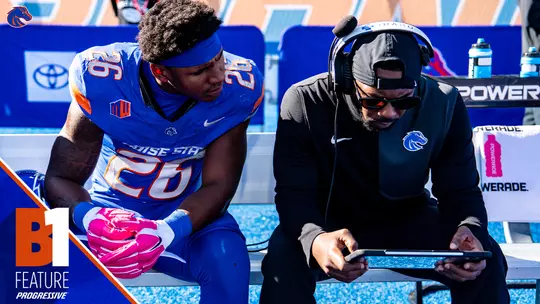
Boise State running backs coach James Montgomery was devastated the moment he realized Dylan Riley’s father, Willie, had passed away.
Montgomery was the one who received the 3 a.m. phone call from Riley with the news. He immediately went into problem-solving, finding the next flight back to his home town before driving his running back to the airport himself later that morning. There was no defense to study, no adjustment needed in pass protection. His running back was grieving, and Montgomery knew something about that feeling. His own father passed away in 2017.
“It’s never the same, but I knew the feeling he was going through,” Montgomery said. “There were some tough times ahead for him because I had some tough times. We were able to talk through all that stuff.”
Almost a year prior, Montgomery provided a shoulder for his other star running back, Sire Gaines, to lean on. As a true freshman in 2024, Gaines was poised to have a breakout season as the backup behind Heisman candidate Ashton Jeanty. After a hot start, he suffered a season-ending injury in his third game.
“For Si, that season-injury was brutal on him,” Montgomery said. “I just try to relate to our guys as much as possible whenever they're going through stuff. I just want to let them know that whatever is going on is not the end of the world.”

Montgomery has been a rock for his two star running backs, whose dominant 1-2 punch leads a room that currently ranks ninth nationally with 234.5 rushing yards per game. Both backs have overcome instances of adversity throughout their careers, and both have leaned heavily on their coach, who has overcome some adversity of his own.
Leaving Rancho Cordova High School in Sacramento as the 14th highest-rated running back prospect in the nation, Montgomery was destined for a bright career after committing to Cal. After a two-year stint with the Golden Bears, he transferred to Washington State, looking to compete for the top spot in Pullman.
However, a strange injury during his third game as a Cougar left him questioning how much football he’d be able to play during the remainder of his junior season.
Later that night, he underwent emergency surgery in an effort to save his leg.
A Star In The Making
Montgomery’s first introduction to football was serving as the unofficial mascot for his brother’s team.
“I’d be out there suited up when I was little,” Montgomery said. “I’d go to his practice and wear my pads and do the whole deal. I joke that that was my first year of football.”
He was attracted to all sports growing up, but after a busy freshman season in which he played baseball, basketball, football and track, Montgomery decided to narrow his focus to football and track for his final three years.
He ended up having a successful track career (he ran a 10.6 in the 100 meters), but it was clear he was destined for the gridiron. Following his freshman season on the junior varsity squad at Rancho Cordova High School, he received his first Division I offer: Portland State.
His career continued to take off. He amassed nearly 2,000 yards rushing his junior season, including one game with 380 yards and nine (yes, nine) touchdowns. He added 2,183 yards and 39 touchdowns as a senior, including three kickoff returns to the end zone. He was named the Sacramento Metro Area Player of the Year following the season, in addition to all-state and all-academic recognition.
Unsurprisingly, offers came in from all over, with most of the programs on the West Coast showing extreme interest. After initially deciding on Washington, he changed his mind and committed to Cal instead. After two years at Cal, Montgomery decided to transfer to Washington State, where he would have two years of eligibility remaining after sitting out a season.
“It was a polar opposite experience,” Montgomery said. “But I loved it. I got scout team player of the year. I was locked into the whole deal.”
Montgomery entered the 2009 season ready to make an impact. He started off with 165 all-purpose yards against Andrew Luck’s Stanford Cardinal in the season-opener. He followed up by recording 118 yards rushing and a touchdown in the week two matchup against Hawaii. Washington State had found its guy.
Following the game against the Rainbow Warriors, Montgomery’s right knee ballooned up, so the athletic training staff took him to get an MRI. The imaging revealed some damage, but nothing he couldn’t play through. He made the decision to get his knee scoped at the end of the year.
The very next game, Montgomery’s life took an abrupt turn.
Taking what he thought was a routine handoff, Montgomery dashed off the left-side edge. There wasn’t an opposing player in his vicinity, but he felt like somebody kicked him and he fell to the ground. He looked around and didn’t see anybody around except his left tackle.
“I'm looking around and literally it's just me and the left tackle on the edge,” Montgomery said. “I was trying to figure out what the heck just happened. I'm looking around but no one was there.”

Adding to the confusion was the fact that Montgomery was able to get up under his own power and walk off to the sideline with seemingly no injury. The athletic trainer took an initial look and thought it was a contusion, an injury that would keep him out of the game but wasn’t too concerning long term.
His knee continued to swell after the game, so to be safe, he was taken to the hospital to get another MRI.
“I’m in the MRI booth and I can just feel my leg swelling up a little bit,” Montgomery said. “It's not painful yet, but it's a little uncomfortable. The MRI technician was telling me that I was moving a lot. It’s boring and tedious. You’re just sitting there looking around, hearing the sounds just taking the images.”
The Swelling Continues
Montgomery was able to walk out of the hospital that same night, but realized there was more pain in his leg than before. Attempting to take his mind off it, he went back to his apartment and began playing video games with his teammates.
Everyone eventually went to bed, but Montgomery was in so much pain he couldn’t sleep.
“I couldn't sleep for anything,” he said. “At this point, the pain was getting much worse. I was starting to wonder if I broke my leg. But I was walking fine the entire night.”
He got up to walk and noticed the swelling around his knee was growing at an alarming rate.
“It felt like somebody was taking a wire and going up and down my leg,” Montgomery said. “It felt like heat and fire. It was so hot. That’s when I really got nervous.”
Montgomery called his girlfriend, who picked him up at 4 a.m. to drive him to the hospital. The doctors ran some tests, starting with an X-ray to make sure his leg wasn’t broken. Once the bone was confirmed to be intact, he was whisked back to the emergency room doctor.
“I remember it so vividly,” Montgomery recalls. “I was sitting with him on a table. He gave me some medicine, so the pain went down. He was looking at me and I remember him starting to type so fast.
“I asked him, ‘Is everything okay?’ He kept his demeanor calm but he was typing so frantically. Then he hit a red alert button. Nurses rushed in and then they called the Washington State team doctor.”

At that point, Montgomery was fed an assortment of pain medication, so his memory is a bit fuzzy. He briefly remembers entering the operating room, with doctors and nurses alike rushing around with a sense of urgency.
He woke up in a hospital bed, with his leg lifted in the air. That’s when he learned the severity of the situation.
Montgomery had experienced acute compartment syndrome, a condition where blood flow becomes constricted to muscle. He had strained his shin and calf muscle, causing internal bleeding. The bleeding spilled out into other compartments in his leg, causing it to swell rapidly.
By the time the doctors opted for surgery, there was nearly a foot of dead muscle tissue inside Montgomery’s leg. If the swelling had traveled past his ankle, the doctors would have been forced to amputate his leg.
At the rate the swelling was progressing, it could have been minutes. Doctors think he had about an hour left at most.
“The first thing going through my mind was that I can’t play football,” Montgomery said. “That’s what I was hearing. I didn’t think I was ever going to be able to play again, so in the moment I was trying to digest that part. That was my identity my whole life. I was having a good season that year. I had waited for my time. There was some frustration, some shock, some disbelief – all those thoughts going around my head in one single moment. It wasn’t until later that I had to process that I almost lost my leg.”
The doctors had cut his entire leg open to remove the dying muscle tissue. He was forced to keep his leg open for three days to make sure there weren’t any infections. His medical team would come by his room every few hours with some saline solution and clean out the wound.
“I couldn't see it because it was wrapped up, but it was open,” Montgomery recalls. “Once they figured out it was all good, they reattached everything. I think I had 48 staples in there.”
Once his leg was reconstructed, the doctors began talking through next steps. The medical team was concerned about his right knee, so they scheduled microfracture surgery, a cutting-edge surgery in those days.
NBA players like Jason Kidd and Amare Stoudemire had undergone that exact surgery. In Montgomery’s eyes, those players were never the same again.
“I thought my playing days were over,” Montgomery said. “I remember calling my grandma at the morning after it happened. I cried like a baby. She reminded me that I still had my leg and everything was going to be okay.”
The Road to Recovery
Even though Montgomery was out of commission, the season rolled on. The Cougar coaching staff made it a priority to make sure Montgomery stayed involved. They had him cut up some basic film packages for the running back room to keep his mind occupied while he was in a walking boot.
Still, he was dejected. In his eyes, his playing days were over.
One day during practice, he walked over to watch the “injury workout”, a modified strength and conditioning session intended for players with minor injuries to stay in shape. These workouts were intentionally difficult.
Prior to the start of workout, his strength coach yelled at him to get ready for warmups. There wasn’t any negotiation: Montgomery was going to participate in the lift.
“Those workouts are hard,” Montgomery said. “My strength coach making me do the injury workout changed the whole trajectory of my life. At that point I wasn’t in a mindset to come back. I was having a pity party. But at that workout I wasn’t allowed to quit. I was really struggling because it was hard. But it made me move and do some football things.”
That one workout turned into another before they became a part of his routine. The routine led to a shift in mindset, and he began to attack his rehab more diligently.
“Next thing you know, I’m starting to believe that I might play again,” Montgomery said. “It made my mindset shift to trying to play one more time. That’s what I told myself my senior year. ‘How can I get myself back to the game and play again?’”

The doctors were worried about drop foot, a condition where the front part of the foot has difficulty lifting when walking, once the staples were removed. In an effort to rehab against it, he would show up in the athletic training room at 6 a.m. sharp. He spent an hour on each leg to ensure he wasn’t favoring one side over the other. He’d also sit on a passive motion machine, which forces the blood to settle and resurface in the lateral meniscus area.
The rehab worked. Once the boot came off, his gait remained unchanged. He had missed all of winter workouts and spring ball on the field but was cleared to do lower leg workouts right before the start of summer.
“I just hit the ground running,” Montgomery said. “I had to learn how to play again. I had to learn how to trust my body during fall camp and get everything rolling. Honestly playing in fall camp again was just awesome. I never took going to practice for granted again. No matter how I felt I was so blessed to be on the field.”
Montgomery jokes that he spent his entire senior year in the training room, but the work paid off. He was ready to go for the first game against the season, a road game against Oklahoma State in which he took nine carries for 37 yards. He followed up with his most productive game in week two against Montana State, totaling 20 carries for 116 yards and a touchdown.
For the season, Montgomery tallied 483 yards and five rushing touchdowns on 121 carries.
“I was so proud of myself for making it back,” Montgomery said. “I cherish the memory of my whole senior year. Just getting to go back out there and play a couple more times meant a whole lot to me.”

The Mentor Role
After graduating, Montgomery returned to Sacramento. His former high school coach brought him to practice, and shortly afterwards Montgomery joined the staff, overseeing the defensive backs and running backs. He worked multiple jobs outside of practice to pay the bills.
When an opportunity to become a graduate assistant at Weber State opened a month before the season, Montgomery didn’t hesitate. The position was on the defensive side, however, opening his eyes to an entirely different side of the ball.
After two seasons at Weber State, a position became available back home at Sacramento State. Though this position was on the offensive side of the ball, it still wasn’t a job with which he had the most expertise. Instead, he became an offensive line coach.
“My first three years of football taught me so much about the scope of the game,” Montgomery said. “It taught me about gap control and how defensive structures work. Then I switched to the offensive line and saw the game from that scope. It was life changing.”
In 2016, the running backs coach position became available. He stayed with Sacramento State until 2020, when he took the same role at Cal Poly. After two years on the beach, he went to Fresno State, coaching a year with the Bulldogs before arriving in the Treasure Valley ahead of the 2023 campaign.
The adversity Montgomery faced during his time at Washington State forged a mindset that has served him well over his career.
“I learned that I’m tougher than I thought I was. I had to approach the game from a whole new perspective. I learned that when you get hit with adversity you just have to keep pushing. It goes in stages, but everyone is going to have adversity at some point, and you have to push through. If you really want to put your mind to something, you can get it done. Even though I wasn't probably 100% ready to get playing, I built myself back up to be able to do it again and really proved something to myself that I didn't think I could do.”James Montgomery
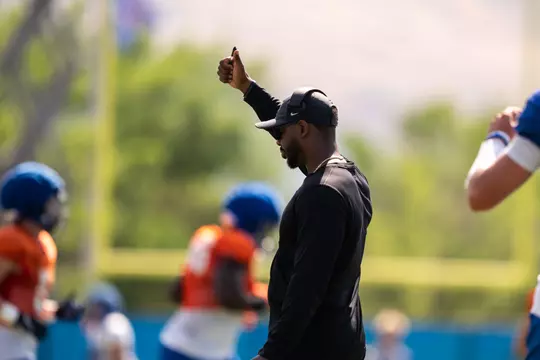
As a coach, Montgomery keeps the focus on his players, rarely, if ever, bringing up his injury. Instead of mentioning the incident directly, he tries to incorporate the lessons he learned over 15 years ago into his daily coaching.
He does, however, like to sprinkle in some clips of himself during the room’s film session.
“It’s always about them, never about me,” Montgomery said. “They’ve seen the scar on my leg, and they know I got injured, but I’m ancient to them. I like to throw in some little jabs, maybe splice some cutups into their film every now and then, just to show them I know what I’m talking about when it comes to pass protection or scoring touchdowns.”
While Riley’s father passed away prior to the 2024 season, Montgomery was one of the first people reached out to. Montgomery, and the running backs room in general, were intentional about supporting Riley through his grief.
“I was able to go into his office before games and talk to him,” Riley said in the spring. “I’ve cried in the meeting rooms with him. I’ve talked about my family with him.”
When Gaines was injured a year prior, Montgomery was the one encouraging him to be around the team as much as possible.
“I knew he needed to stay around the team and he did a really good job just coming back,” Montgomery said. “The first day after the surgery, he was in the weight room at 6 a.m. with the guys. We kept him involved with everything.”
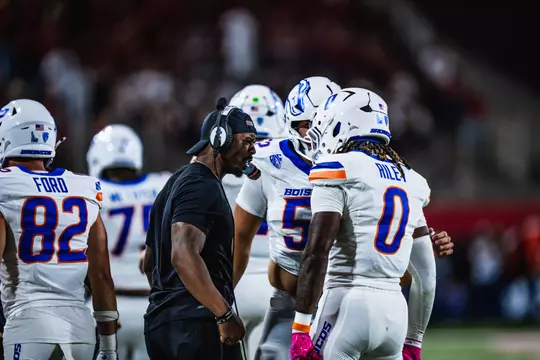
Montgomery is one of the rising stars in the coaching industry, with an impressive resume to back it up. Under his watch, Jeanty broke out as one of the best players in college football history, becoming Boise State’s first unanimous All-American, Maxwell Award winner and Doak Walker Award recipient. Led by Jeanty, the Boise State run game finished the 2024 campaign ranked eighth in the country by averaging 240.4 yards per game. This followed the 2023 season - Montgomery’s first on staff - in which the Broncos were ranked sixth in the nation in rushing offense with 214.9 yards per game.
Despite Jeanty’s departure, the Stable keeps attacking. Riley is the nation’s leading rusher with 835 yards and is ranked second nationally with 139.2 yards per game. Gaines has missed two games on the season but has still totaled 354 yards and three touchdowns. Together, the duo has the Broncos averaging 234.5 yards per game, the ninth-most across the country. Never was their dominance more apparent than the team’s final drive last week against Fresno State when the Bronco offense called 13 consecutive run plays to set up Canaan Moore’s game-sealing field goal.
“Dylan, Sire, they’ve been here three years now,” Montgomery said. “They’re vets. They look different, they play different, which is good. That’s due to a lot of work but when you look back, it happened so fast. I try to make sure they maximize every single day. I try to push them as much as I can as a coach because there’s no looking back.
“It takes the game being taken from you to give you that perspective,” Montgomery said. “I don’t try to be morbid with our guys but they’ve all felt it in some way. They’ve had that feeling before so they’re just out there trying to maximize their talent. You can see that with how they’re working this year.”
The production on the field is undeniable. So too is the connection off it. The entire running back room will go out for dinner once a week, a tradition Montgomery started when he came to Boise State. There’s only one rule at these Thursday night dinners: no football talk.
That room is as close as ever. The room knows it can depend on one another. The room knows it can depend on its coach.
“I’ve gone through some loss. I’ve had season-ending injuries. I’ve been late to weights a few times and got in trouble. Every situation they’re going to be in, I’ve been in.”James Montgomery
Though his injury shifted his perspective, Montgomery shies away from bringing it up directly. Instead, he emphasizes the rarity of being able to take part in college football. To take part in being part of a program like Boise State. To take part in being a part of a brotherhood like The Stable.
“Once it ends, you’ll never get the feeling again of running through the tunnel, or scoring a touchdown, or making a play,” he said. “You can’t simulate running out in front of 40,000 people. You can’t simulate the hecklers at away games. You can’t simulate silencing a crowd with a big play.”
He knows the pressure of playing college football, especially in a place like Boise State. Entering the bye week with a 5-1 record, expectations are soaring in the Treasure Valley. Montgomery knows how to deal with that too.
“When our guys feel like the weight of the world is on their shoulders because of the pressure of college football, I can let them know there’s harder stuff,” Montgomery said. “It’s just a game. We’re going to get everything fixed. I try to make myself see things from their perspective a lot of the time and find the best way to ease their mind.”
He relishes the role of mentor. The best part of his job is when he can make a meaningful difference in his players’ lives. When he encounters someone who is dealing with adversity, whether it be one of his players or someone in his life, he doesn’t bring up his story. But he does give the same advice; advice he learned the hard way.
“I let them know that they're probably a little bit stronger than they think they are.”