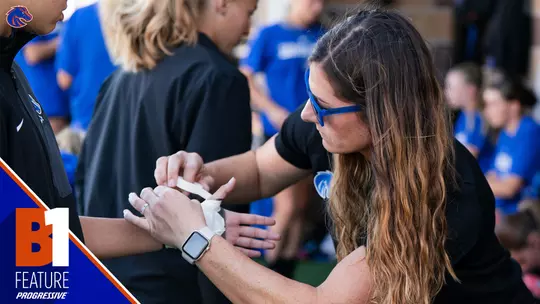
Camryn Edens
Athletic training requires more than classroom knowledge. Students must learn to make decisions, communicate effectively and care for athletes in high-pressure situations.
For 50 years, Boise State has helped prepare future athletic trainers for those moments by combining academic instruction with real-world experience through its partnership with Boise State Athletics. Students work alongside experienced athletic trainers, learning what it takes to care for collegiate athletes across multiple sports.
Through eight-week clinical rotations, Boise State Athletics staff serve as preceptors, guiding students as they develop the skills needed to enter the profession.
For Matt Schofield, an assistant athletic trainer with Boise State women’s basketball, that mentorship means giving students an inside look of the demands of giving care to athletes.
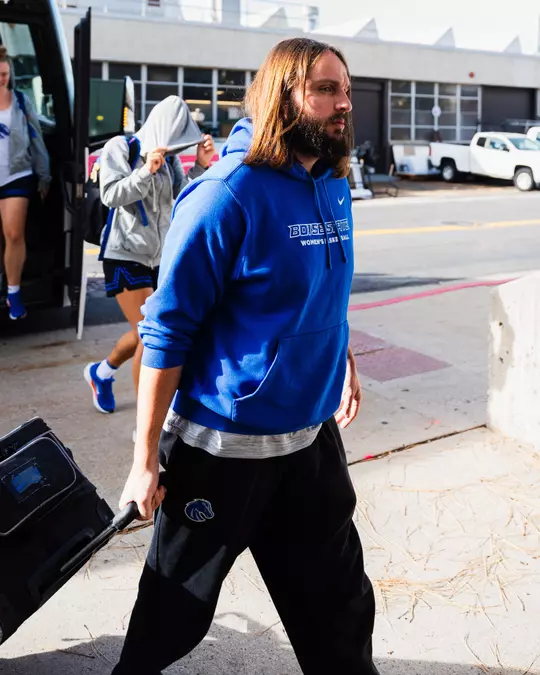
“Students are following athletic trainers throughout their job,” Schofield said. “They'll come over from class for practice, treatment, all of that kind of stuff. It gives us (as full-time athletic trainers) an opportunity to be involved with the students, show them our day-to-day, teach them how we approach our jobs and help apply some of the conceptual things they learn in class to the clinical setting. Essentially, we give them their internship experience to see what the job's actually like.”
Schofield also has the opportunity to guest lecture in one of the classes, sharing his expertise in dry needling. Despite his extensive education and certifications, he demonstrates to students that athletic training is a field rooted in decades of knowledge and built on a lifetime of learning.
HISTORY
Boise State’s athletic training program began taking shape in 1976, when the university introduced a formal degree pathway. Ron Pfeiffer, the program’s first director, and Gary Craner, Boise State Athletics’ retired head athletic trainer, helped build a model that combined classroom learning with hands-on experience.
Craner joined Boise State in 1972 and helped establish an educational process that connected students with athletics. The program soon developed a reputation for preparing athletic trainers for careers across the industry.
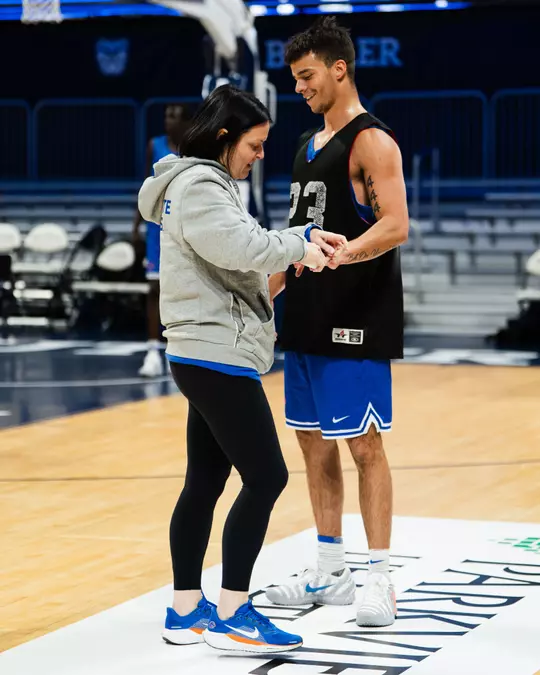
Dave Hammons, the program’s current director, experienced that tradition firsthand. A Caldwell native, he earned his undergraduate degree at Boise State under Pfeiffer and Craner before working at three other universities. He later returned to lead the program.
Dave Hammons, the program’s current director, experienced that tradition firsthand. A Caldwell native, he earned his undergraduate degree at Boise State under Pfeiffer and Craner before working at three other universities. He later returned to lead the program.
Boise State earned national accreditation in 1982, the year accreditation began, and has maintained it ever since.
Today, students complete a two-year, approximately 50-credit Master of Athletic Training degree. The program combines rigorous coursework with extensive clinical experience, continuing a tradition that connects academics and Boise State Athletics.
“We are very fortunate in our program,” Hammons said. “It’s been a very vital part of the education program to have athletics as a site where we can send students to.”
HANDS-ON LEARNING
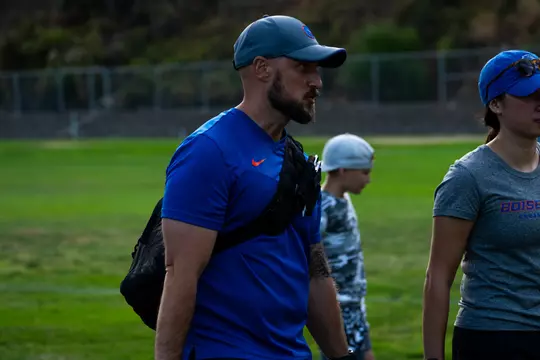
The learning experience extends beyond Boise State. Students complete rotations throughout the Treasure Valley, with approximately 40 clinical affiliations exposing them to different patient populations and health care settings.
Graduates go on to work in high schools, rehabilitation clinics, hospitals, youth sports, industrial settings and the military, among other fields.
For Hammons, watching students grow in confidence is one of the most rewarding parts of the job.
We want students to be able to make real decisions. Whenever you see that happen, that's pretty remarkable to see how much it improves the student's confidence.Dave Hammonds
MUTUALLY BENEFICAL
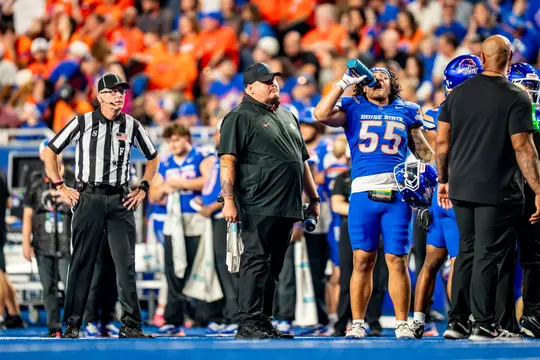
The partnership between Boise State Athletics and the academic program benefits students and the professionals who mentor them.
Marc Paul, Boise State’s associate athletic director for Sports Performance, Health & Wellness, said teaching students encourages athletic trainers to stay current with new developments in health care.
“We've got young people who want to enter the profession,” Paul said. “That curiosity keeps the staff as preceptors for those students on our toes.”
Schofield agreed, saying that students sometimes even teach him new techniques in the field he has been involved in for years.
Education is always changing. One of the most important parts about being an athletic trainer is staying up to date on the current standards and practices so that we can best support our student athletes. It is a nice way to stay in touch with what the most recent educational standards are.Matt Schofield
Paul mentioned he was drawn to Boise State nearly 20 years ago partly because of the program’s reputation. He had encountered its influence earlier in his career through a study guide written by former Boise State professor John McChesney, which he still owns.
“One of my study guides that I used when I became certified 30 years ago was a book put together by a professor here in our athletic training program, John McChesney,” Paul said. “I still have it to this day. It's been around a long time and has been really high quality for a long time, it's really a feather in our cap.”
Athletic training students also help build connections with Bronco student-athletes. Because students are often close in age to the athletes they support, they can develop relationships that encourage trust and communication.
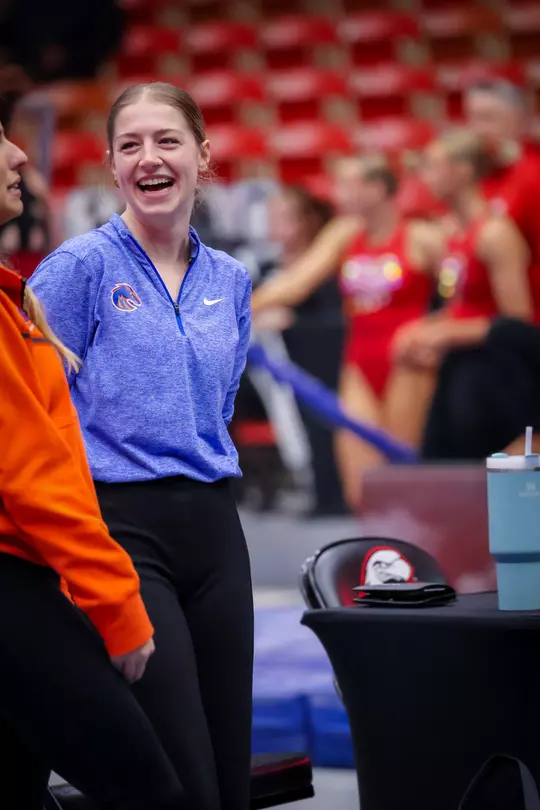
Those skills are especially important when athletes face injuries and the frustration of being unable to compete.
“Nobody wants to be hurt. Nobody wants to be told they can't play,” Paul said.
Students learn to communicate with empathy, maintain professional boundaries and understand the emotional challenges of injury and rehabilitation. They also experience the intensity of collegiate athletics and learn to support athletes through stressful moments.
A LEGACY OF CARE
Boise State’s sports medicine history includes the lasting contributions of Dr. George A. Wade, who helped advance care for Bronco student-athletes over six decades.
Wade moved to Boise in 1978 after an athletic and medical career that included All-American honors in track and field at Michigan, medical school at Tennessee and a sports medicine fellowship at the Kerlan-Jobe Clinic in Los Angeles.
He began working with Dr. Richard Gardner, Idaho’s first sports medicine orthopedist and Boise State’s original team physician. Wade succeeded Gardner in 1979 and established the Idaho Sports Medicine Institute (ISMI).
In 1984, the partnership between Wade, ISMI and Boise State took a significant step forward when the clinic moved into its current space in Albertsons Stadium. The arrangement established the first privately owned medical facility on a state-owned university campus in the United States, creating a model for collaboration between sports medicine providers and collegiate athletics.
Wade was inducted into the Boise State Athletics Hall of Fame in 2020 and died in June 2025 at age 82.
“Dr. George Wade was more than a physician—he was a pioneer whose vision and leadership transformed the way we care for Bronco student-athletes,” Paul said following Wade's passing. “His commitment to innovation and excellence set a new national standard, and his legacy lives on through our continued partnership with ISMI and the countless lives he impacted over his six decades of service.”
Wade’s legacy reflects the importance of collaboration in athlete care. The university’s partnerships with medical professionals and its academic program continue to support student-athlete well-being while preparing future athletic trainers.
PREPARING THE NEXT GENERATION
Boise State’s Athletic Training Program reports a 95% job placement rate at graduation, rising to 100% for its most recent spring graduating class. Some students secure jobs before graduation, while others pursue medical school, physician assistant programs or additional education.
The program’s first-time Board of Certification pass rate is 90.5%, compared with the national average of 70.5%.
For Hammons, those results reflect a continued emphasis on helping students understand the material and apply it in professional settings. The program's evolution has opened doors to a wider range of careers while preserving the hands-on approach that has defined its history.
As Boise State looks towards another 50 years of athletic training, the fundamentals of the program will remain unchanged: strong academic preparation, meaningful clinical experience and a close relationship with Boise State Athletics.
We're never going to lose sight of our history in athletic training. That's one thing that's central to me as the program director, along with working with Athletics. They respect the academic side, too, and really take ownership in mentoring future athletic trainers.Dave Hammonds
As Boise State celebrates 50 years of athletic training education, its legacy extends beyond degrees and professional certifications. It lives in the relationships among students, educators, athletic trainers and medical professionals.
The program continues to build on its collaboration and prepare future athletic trainers to care for Broncos and communities beyond Boise State.