
David Dietrich
When facing a serious health issue, people are often told they will have to adjust to a “new normal.” The illness they battle may force changes in lifestyle to adapt to the physical, mental and emotional toll caused by the disease. Perhaps no health issue is more serious than cancer, which is diagnosed in roughly 20 million people across the world each year. One of the individuals diagnosed was Christian Graham, a distance runner for the Boise State cross country and track and field teams. While home in Scotland before his final year with the Broncos, the graduate student was told he had B-cell non-Hodgkin lymphoma, a cancer that affects the body’s ability to fight infection with blood cells. Stunned by the news, Graham entered his fight with two goals: win, then live a life that was more “old normal” than new.
A lifelong athlete, Graham grew up in Edinburgh, Scotland, playing soccer before turning his attention to running. His youth success took him to nearby Dundee University, where he earned a degree in graphic design and placed 13th in the Scottish National Cross Country Championships. He wanted to follow in the footsteps, literally, of his older friends who had transferred to an American institution to complete a master’s degree and compete in the NCAA. Graham joined Boise State for the 2023-24 season, racing in the conference and regional cross country meets before a successful indoor track season. Injury forced him to miss the outdoor season, and shortly after, he realized there may be a larger health concern.

“I woke up one day, looked in the mirror and saw these lumps on the side of my face,” he explained. His girlfriend confirmed the abnormality, which was enough to convince him to visit the health clinic. Although there was no initial diagnosis, he returned a week later and was prescribed an antibiotic after the lumps increased in size. When those had no effect, he saw a specialist in Meridian, who ordered a steroid treatment and CT scan. The scan revealed the lumps appeared to be some sort of fluid-filled mass. With Graham set to fly back to Scotland, he was instructed to see a different specialist at home who could work through options, such as surgery. After an MRI, the lumps continued to decrease in size, but Graham anxiously awaited the results.
“It was a pretty unsettling four or five weeks. I didn't know what was going on. I was still injured, which was on my mind because I wanted to be injury-free and get fit for cross country season,” he said. “That was at the top of my list and I was trying to put everything on the back burner. I didn't realize how much of a problem this was going to be.”
Two weeks before he was set to return to the Treasure Valley, Graham’s hometown doctor called with an alarming update: the lumps were solid. Graham’s entire life came to a screeching halt after a biopsy confirmed he had cancer. His flight to the Gem State was canceled and he began treatment, but not before informing head coach Pat McCurry, who had yet to meet Graham in-person after starting the job in early June.

“When I got the job, Christian was already back in Scotland, so all the communication on his diagnosis, treatment and our plan going forward here was over the phone,” said McCurry. “Navigating something as weighty as cancer with someone you just 'met' virtually was an odd space for both of us.”
“I know you're probably not thinking about it at this point in time, but if you want to come back once you've gotten through all this, then that's definitely going to be possible for you,” McCurry told Graham during their phone call. That was all Graham needed to hear as he geared up for the grueling process of chemotherapy.
“That was definitely the main thing I worked towards,” he said. “I had to have a goal through all of it. You don't fight just to have nothing to look forward to.”
While McCurry connected with various staff members at Boise State to work through the logistics of pausing Graham’s athletic and academic pursuits, Graham entered what he calls “the longest three months of my life.”
A constant competitor, he approached the treatment as a training session. His consultant was positive from the start, citing his skills as a collegiate athlete as a massive advantage in enduring the chemotherapy. Graham considers himself lucky to have encountered the disease when he did, crediting his fitness, youth and early diagnosis for his ability to go through a more intense treatment than what is typically recommended.
“You’re in the best position possible because you’re so fit,” she told him. “You have the VO2 max, aerobic capacity and cardiovascular health to help you fight this thing.”
Wanting to get the disease out of his system as quickly as possible, Graham ramped up his treatment when he received good news about the cancer not spreading to the rest of his body, which he credits to the steroids he took after his initial appointments in Idaho. For three months, he underwent treatment and slowly built a routine. Graham spent three weeks at the hospital, then returned home when chemotherapy was paused because of the strain it placed on his blood cells. As soon as his blood counts reached the threshold where it was safe to return to the hospital, he went right back for treatment.
Graham credits the United Kingdom’s Teenage Cancer Trust for their support and resources, which were especially useful when he was limited to only having visits from his parents and girlfriend. The support charity provides funding and services for people aged 13-24, as well as specialists in the field. “They treat you like you’re on your way in, not your way out,” he said. “I had a lot of great services at my disposal.”
When treatment ended and the cancer was removed, Graham was given the clearance to gradually resume training, but he was warned about having to adjust to the “new normal.” His reaction?
“Screw that.”


Determined to reach the fitness level he had before his diagnosis, Graham began running again, realizing quickly he had a long journey ahead. His first attempts at jogging lasted barely a minute, with his heart rate skyrocketing to nearly 200 beats per minute. One day at a time, he continued his progression, noticing milestones along the way, such as hair growth, increased appetite and even the ability to drink coffee again.
“I just had to keep telling myself that every day I gain a little bit of blood mass and the more I run, the quicker I'm going to get that blood mass back,” he said. “Then when it does come back, I'm going to be able to train as I would, or at least give it a crack.”
At the start of the year, Graham completed a 30-minute run without stopping and became even more confident in his chances to return to normalcy. In February, he ran a local race. In March, he booked a flight to Boise, where he officially met McCurry and caught up with his teammates.

“That visit alone seemed like such a win, as he had come through treatment with great results and was already back running,” said McCurry. “The coolest thing was seeing him interact with his teammates. Their support of him and relief to have him back around were certainly visible.”
“Everyone was asking, ‘How on earth are you doing this?’ I just had to keep chipping away,” said Graham. “As an athlete, I'm used to being in situations where I’m expected to work really hard and be comfortable feeling really uncomfortable.”
He embraced the discomfort as he trained even harder over the summer. Just months removed from treatment, he finished second in the Edinburgh Half Marathon while raising over $4,000 for Teenage Cancer Trust. When it came time to rejoin the Broncos, Graham was more than ready.
“I made it clear that I wanted to come back, compete and contribute,” he said. “Just because I've been ill didn’t mean anything, as far as I was concerned.”
Thanks to McCurry, the rest of the staff at Boise State and countless health care workers, Graham returned to his normal routine of graduate school and cross country.
“We told him his scholarship was good to return and finish his degree when he could, regardless of whether he could run,” explained McCurry. “It wasn't until that visit when we began to really entertain what he might be capable of. He certainly surpassed any expectation we had.”
Surpassed might be an understatement, considering Graham’s performance in his first meet back. He placed 15th in the 8k at Notre Dame’s Joe Piane Invitational, running a career-best 23:13.8 and helping the Broncos finish second in the Blue Division. He followed with more strong performances in the Mountain West Championships, where Boise State finished second, and NCAA West Regionals, where the Blue and Orange took fourth. In both meets, he improved on his time from the 2023 season, narrowly missing a spot on the NCAA All-Region team.
Graham has already added lifetime-best marks in the mile and 3k during the indoor track season, making a memorable final season even more impressive.
When you work hard toward something, there are always ifs and buts about whether or not it's actually going to happen. When you get there and you do it, it’s more fulfilling than you could have imagined.Christian Graham
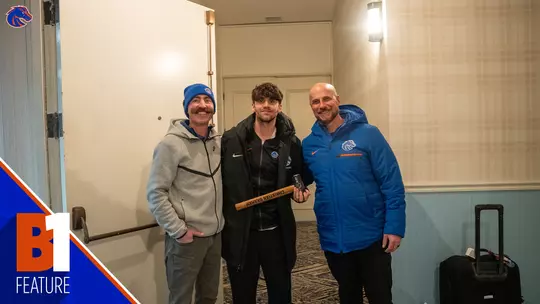
His hard work did not go unnoticed by associate athletic trainer Tyler Smith, who presented Graham with the Hammer of Resilience. The award is given to a Bronco student-athlete who advanced through their recovery after a significant injury. It held special meaning to Smith, who had witnessed Graham’s determination firsthand.

“This was the first Hammer of Resilience award I have handed out and I couldn't think of a more deserving person. The award is special to the sports medicine staff. It represents those athletes who have overcome huge obstacles and done it in the right way. It represents all the hard work, determination and effort that they put in coming back,” said Smith. “It was apparent from the first day Christian was cleared to start that his mind was made up. He was returning to racing and wanted to do so at the highest level he could. You could see he was determined and wasn't going to let this cancer define him moving forward.”
“I’m very grateful they gave me the award. I think it’s valuable to share my story. It’s pretty uncommon for someone at my age and fitness level to be diagnosed. I had this normal life, then a big black hole in the middle,” Graham said. “Your brain does weird things. It decides to forget what you don't want to remember. It almost seems as if it didn't happen. I'm a year older, which is strange, but it’s not a new normal.”
Now preparing for the MW Indoor Track and Field Championships before his last laps during the outdoor season, Graham isn’t taking the opportunity to compete for granted.
“I appreciate the small things like being able to run, even if it's raining, even if it's windy, even if I'm sore. I'm still super happy to have that and to have the cross country season I did,” he said. “The NCAA is all about experiences. You get to go on these amazing trips. We get to be part of a team, make memories and make lifelong friends. At one point in time, I thought that was going to be cut short.”
Graham also appreciates the chance to inspire others fighting the same battle, urging them to reclaim the life they had.
“There’s no reason to say anybody who gets ill can't get the exact normal they had before,” he said. “You don’t need a new normal. You can have your old normal.”
He is happily living his “old normal life,” but considering his journey over the last 18 months, what Graham is achieving this year is anything but normal.