
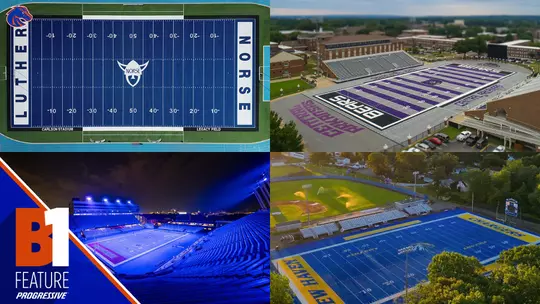
The Blue: Inspiring Fields Across The Nation
Around midafternoon on Saturday, thousands of members of Bronco Nation will converge Albertsons Stadium, eager to watch the Blue and Orange in their home opener against an undefeated Memphis team.
Fans attending will get to experience plenty of “new” as the 2026 campaign kicks off. After enjoying games alongside a protruding giant red crane in 2025, fans will experience the shiny new North End Zone. The finished product will allow for a new twist on the team runout, and new ribbon boards throughout the stadium will be noticeable to all patrons.
No matter how rapidly Albertsons Stadium continues to improve, one thing remains certain: there’s no bigger draw than The Blue itself.
The seventh iteration of the blue turf will be on display for football fans to enjoy when the Broncos face off against the Tigers (4 p.m. MT/USA Sports). Several new touches, including orange hash marks honoring past Bronco legends Kellen Moore and Ashton Jeanty, will be visible for the first time.
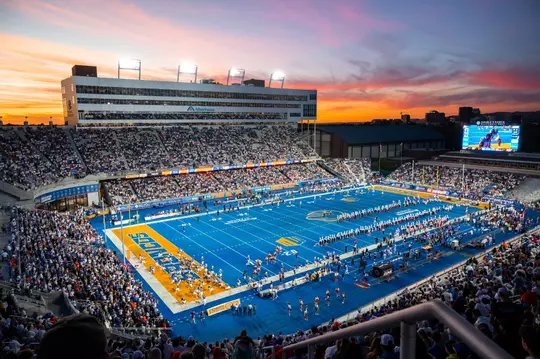
Forty years ago, then-athletic director Gene Bleymaier made the bold decision to install the blue turf. It has survived numerous critics and naysayers to become one of the most recognizable icons across the college football landscape. Last year, The Blue hosted over 21,000 visitors from all 50 states and 48 different countries. Voted the top sports attraction for sports fans by USA Today for three consecutive years, it has become a sacred piece of college football history.
The Blue has inspired Boise State to be bold and different, and is a perfect symbol of the rise of the Bronco football program. Starting with a 74-0 thrashing in its debut in 1986, The Blue has become synonymous with Boise State’s winning tradition (the Broncos have won 82.6% of their games on the blue turf, including an 89.6% mark (147-17) since 2000, the third-best in the nation).
That inspirational decision 40 years ago inspired several other colleges across the country to be bold and change the color of the field at their own stadiums. In this week’s B1 Feature, we examine some of these schools’ stories.
Estes Stadium – Central Arkansas
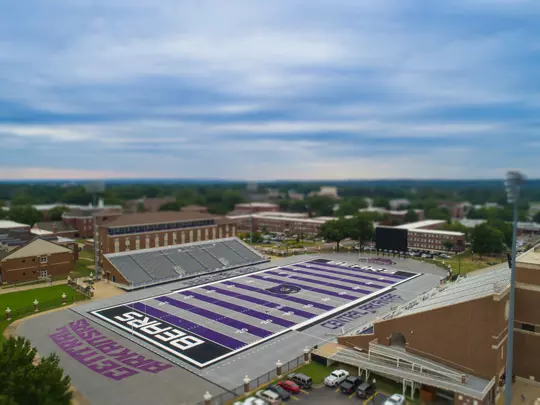
To college football fans who resided outside the state, Arkansas belonged to the Razorbacks. The storied program was, to most people, the only team fans could name in the state.
Brad Teague, the athletic director at Central Arkansas from 2007 until he retired in 2024, wanted to change that.
In just his fourth year as an athletic director, he facilitated the Bears’ move to the Division I FCS level, joining the Southland Conference for the 2010 season. But he still wanted to make a splash.
“We were known as this little NAIA school that won all those championships in the 80s,” Teague said. “That’s what people thought about us. We wanted to change that.”
The Bears were the only school in the Southland Conference that was still playing on natural grass.
“We thought it was an advantage,” Teague said. “Our coach at the time thought it was an issue that we could never practice on the game field. He told me that he thought it was time to go the way of synthetic turf.”
Teague called a meeting, consisting of himself, the marketing director, and the creative director. He encouraged the three-person team to come up with some creative designs.
The group sat around a computer and created makeshift mockups of what the field could look like. Most were unique and strayed far from the usual green. The idea that came out of the room was a purple and gray field, alternating between each 5-yard line.
“I loved it,” Teague said, “but I didn’t want it to just be my call. It was a big decision and I wanted it to go to a larger group.”
Teague and his staff created a fan contest, allowing the stakeholders (students, donors, sponsors, coaches, student-athletes, etc.) to have a say. Some of the ideas included an all-purple field, a purple “red zone” area, and other unique variations.
The winning design? The one that came out of the original three-person meeting.
With the fun part out of the way, Teague got to work finalizing all details. He contacted the NCAA and Boise State, the latter of which granted them the license to use artificial purple turf.
The year prior in 2010, LSU made an announcement about changing their field on April Fool’s Day. Inspired by the idea, Teague made his school’s announcement a year later on the same date.
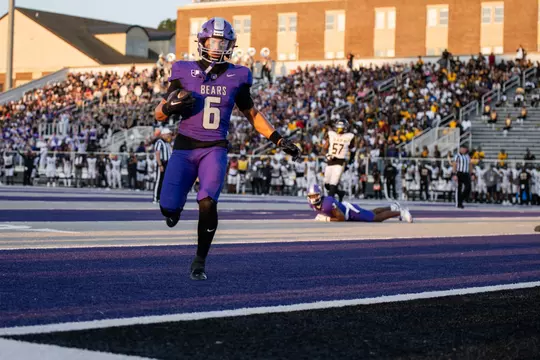
“LSU was kidding and we were not, so it ended up being a lot of fun,” Teague said. “We had a lot of play with it. A lot of national news stations across the country were calling in to see if it was real. A lot of people thought it was an April Fool’s joke, but our fans thought it was incredible once they realized we could actually do it. The majority of our fan base was stoked.”
Despite the obvious success, the decision didn’t come without detractors.
“We did have some old-school folks who didn’t like it,” Teague conceded. “I got asked if fans would get dizzy watching football. Then you start playing and you don’t even notice the field after the first few plays. Over time, people came to love it. We’re proud of it, and it ended up becoming a really good move. It was an extremely positive reaction.”
The success has undoubtedly paid off. Central Arkansas boasts a 58-20 record since installing “The Stripes,” including a perfect 11-0 in the first two seasons of its existence.
“We wanted to differentiate ourselves as an FCS program,” Teague said. “We wanted to have national recognition. We wanted to be known as the school with the stripes, and that has happened no doubt. It’s a great recruiting tool and our student-athletes love it.”
Working in tandem with the on-field success of the program, The Stripes took off. In 2021, the University replaced the turf for the first time since the original installation, showcasing the significance of the original decision.
“It’s something that has endeared us, not only to our fans, but to national football fans. We’ve had various social media folks with a great following and great recognition who come to our field solely to take pictures. When I was still the athletic director, my office overlooked the field, and I could always witness people stopping to take pictures on The Stripes. It happened all the time and was always fun to see."Brad Teague, former Central Arkansas athletic director
“The cool thing is you can see main street from the field,” Teague said. “We get a lot of good visitors and traffic and people stopping to take photos consistently. School buses stop when they drive through. It’s become a real focal point of our community. Every tour that our admissions office gives, all those groups come to the stripes to get photos. People just want to see it. Fifteen years later and it’s become our identity. Not just for the athletic department, but for our university as well.”
The field helped shape the branding of the athletic department and aided a successful tenure for the football program. But maybe most importantly, Teague argues, it allowed staff members campuswide to embrace creative problem-solving.
“It helped us with innovation by believing we could do things differently,” Teague said. “It gave our staff permission to think outside the box and be different over the years. Whether it was on social media, creative video, getting ESPN to campus – there were a lot of things that we tried to do before others would do it. We wanted to be innovative, an athletic department that was willing to think outside the box.”
Teague, who still serves as a consultant to Central Arkansas’s athletic department, points to Boise State as a school that helped pave the way for the idea of The Stripes to even take place.
“We would not have done it if not for Boise State having already done it,” Teague said. “We could at least look at Boise State and point to it and see the kind of branding and recognition that it gave them. It certainly gave us the confidence to try something different as well, knowing there was a blueprint for it to work.”
Legacy Field in Carlson Stadium - Luther College
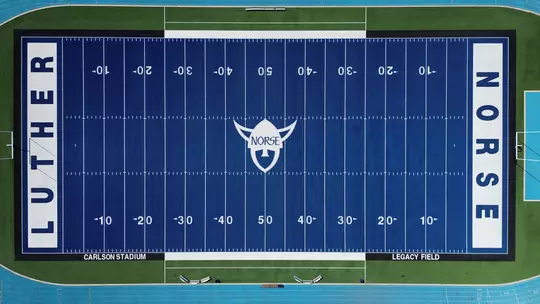
Renae Hartl was in the middle of her second season serving concurrently as the athletic director and head softball coach for Luther College, a Division III program located in Decorah, Iowa, a town of just over 7,000 in the northeast part of the state.
It was December of 2016. As the softball coach, Hartl led the Norse to a 38-6 record and Division III regional appearance. As the athletic director of the only school in the American Rivers Conference whose football team played on a grass field, she was in the beginning stages of figuring out what installing a turf field would look like.
In between gearing up for what little downtime a person serving as an athletic director and softball coach can have, Hartl sat down to watch college football bowl games over the winter break. One of the games was the 2016 Famous Idaho Potato Bowl, featuring a high-scoring shootout between Idaho and Colorado State.
“It must have been a great game because my football coach at the time was talking about the game the next morning,” Hartl said. “I made a comment about how unique the field was while watching it on TV. We both loved it.”
The conversation sparked an idea, an idea that began to take life in January. By that time, President Paula Carlson and the Luther Board of Regents had decided to switch to turf. After conversations continued, the pair pitched the idea of using the school’s colors instead of a traditional green playing surface.
“We were trying to make ourselves unique and distinct,” Renae Hartl said. “There are so many Division III football programs within three hours of us. We were trying to figure something out that would make us special. We wanted to stand out. If a young man was going to look at a lot of campuses, football fields and coaches, what were they going to remember the most? We wanted something to make us special, make us unique, make us distinct, and make us memorable. That was really our goal.”
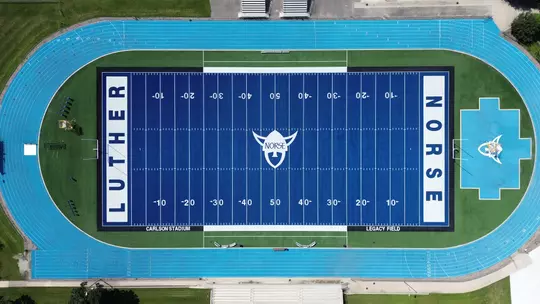
On Jan. 20, 2017, Hartl reached out to Boise State, asking to see if it was possible to secure a different shade of blue-colored turf color. Roughly a month later, Boise State gave permission to Luther, allowing the Norse to become the first Division III football field to do so.
With the legalities confirmed, Hartl and some staffers met with some of Luther’s biggest donors. They were all excited with the unique idea, giving Hartl and co. their blessing to proceed with the vision.
The announcement came shortly after, creating an unrivaled excitement around the local community.
“Our fan base loved it,” Hartl said. “Even our oldest fans loved it. There was really zero negativity from our fanbase.”
The teams from the conference, however, weren’t as thrilled.
“It was interesting to see the pushback of us having a blue field,” Hartl said. “A lot of teams in our conference didn’t want us to wear blue uniforms on our blue field. There were rumors going around that a lot of birds have died on our field, and this is not the case. There were complaints that our opponents were at a disadvantage watching film. We enjoyed the heated conversation and pushback during the transition.”
In the present day, the field has become a symbol of campus identity. Alums come back to take pictures, and the field is a prominent part of each visit given not only to prospective student-athletes, but all campus tours.
“Boise State gets mentioned on every single tour that we give,” Hartl said. “It’s literally on the tour guide manual that Luther College obtained the licensing from Boise State to do this. Every family that goes on tour here hears that agreement that we came upon. And pretty much every alum that comes to campus will almost always go take their picture on the blue turf before they leave. That’s pretty special.”
Hartl, who is entering her 26th year as a softball coach and now serves as the senior woman administrator in the athletic department, looks back on the process of working with Boise State officials to bring a blue turf to northeast Iowa.
“Boise State was really easy to work with,” she said. “It was a pleasant experience. It took some work, but it was totally worth it to have this really cool thing. Bringing blue turf to our campus is something that I’m really proud of during that era of Luther Athletics. I hope we can continue our relationship with Boise State in the coming decades. We love that it is one of our special things at Luther College in the northeast corner of Iowa.”
Ralph F. DellaCamera Stadium - New Haven
Devin Crosby remembers reading about New Haven discontinuing its football program in 2003 when he was a high school student. The Chargers, located in West Haven, Conn., played a lot of schools in western Pennsylvania and Maryland at the time, and he recalls hearing about the decision all the way in his hometown of Pittsburgh.
Fast forward to 2009, and New Haven athletic director Deborah Chin was ready to bring football back. The program was reinstated that year, but Chin wanted to make headlines with the return.
“She wanted to make a bold statement that football was back and was here to stay,” Crosby, currently in his third year as the athletic director at New Haven, said. “That was the impetus of doing something different.”
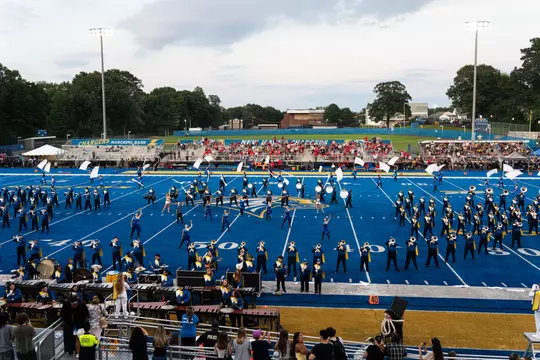
Right from the start, Chin wanted to make a lasting impression. Working with Ralph DellaCamera, a member of the Board of Trustees, she secured the funds to redesign the football field with a blue and gold design. She obtained the license in 2009, allowing for the field to open on Sept. 19, 2009. The turf has remained blue ever since.
The athletic department has embraced the change and the new-look football program had success seemingly right out of the gate. After a 5-5 mark in 2009, the Chargers rattled off three consecutive conference championships. Their 5-5 record that season remains the worst record New Haven has seen on the field until last year, when it finished with the same record.
However, last year was the program’s first year after making the jump to the FCS level. And New Haven was a perfect 4-0 on its home turf during its inaugural season as a Division I program.
“Football is very special to us at New Haven,” Crosby said. “We're a little bit bullish, and we're probably a little bit biased, but we feel that we're trending towards being the best football program in the Northeast. We really feel that way. And we say that very unapologetically. That’s why the Blue and Gold means so much to us. It sets us apart, just as much as we feel we’re setting ourselves apart competitively with our student-athletes. That’s what the Blue and Gold represents. There’s nothing like it here in the Northeast.”
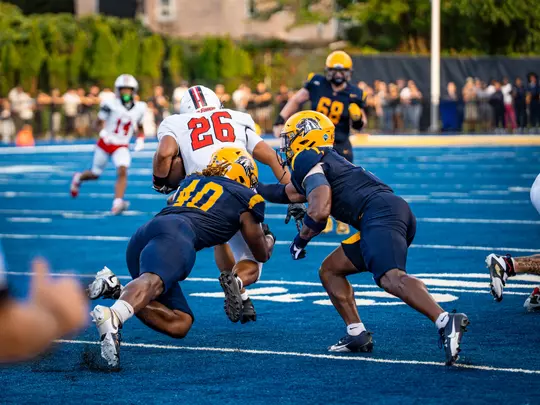
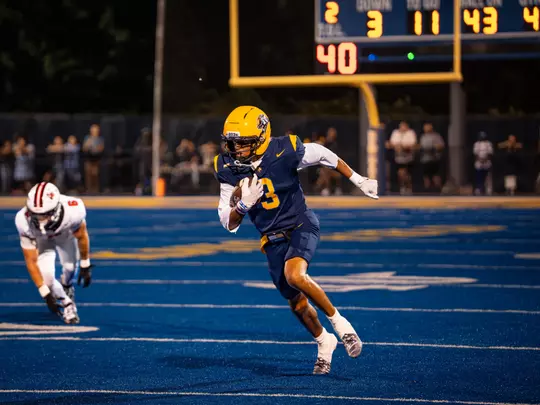
The field has become a common gathering point for the alumni of the program, even those who were Chargers before the field changed colors.
“For our alums, our former football players, they love it,” Crosby said. “It’s that point of pride. The other teams we play realize it too. Our winning percentage is around 80%. We do really well at home. The Blue and Gold has become an identity of our campus.”
“I've never worked at an athletics department or a university that has a football brotherhood this tight, this close, this connected,” Crosby said. “I've never seen anything like it in my life. We will be over capacity this year for our football home games. Last year, we were, I think, at 120% capacity for homecoming. Our games are packed. It’s standing room only. It’s really special.”
The field has become a point of identity for not only the athletic department, but the campus as a whole.
“The field is a part of the entire process we have for any student that comes on this campus,” he said. “Our goal is to get them right onto the Blue and Gold, every single student. It works, because people want to be a part of something that’s bigger than them. If you have an iconic field like that, you can use it to your advantage.”
The landmark has become a common identifier around the campus community, as New Haven continues to try to elevate itself among the schools in the area. From an athletics standpoint, Crosby found a way for the Chargers to host Penn State for a game in early November. Campus wise, the University is starting a branch campus in Saudi Arabia.
“We like to do bold things here,” Crosby said. “We like to think we’re reimagining Division I. We’re in the midst of all the changes in Division I, higher education, but that’s where you find opportunity. We’re bold thinkers.”
Bold thinkers. Sound familiar, Bronco Nation?